Part 2: The Bracelet No One Wanted Her To Open
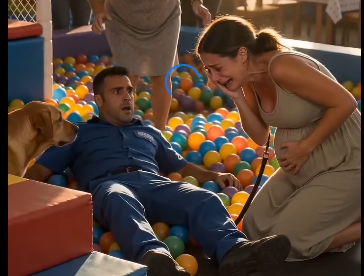
Esther held the torn bracelet between two trembling fingers while the entire play center seemed to shrink around her. The colored balls still rolled softly where Rayo had pushed the owner back, clicking against plastic walls like nervous teeth.
The name on the bracelet was not the name of Kevin’s son.
It said Nicolás Weber.
Below it, written in rushed blue ink, were the words that made Esther’s stomach tighten around the baby inside her.
Do not sign anything. They will blame you too.
The owner’s face changed before anyone else understood. His hand shot toward the bracelet, but Rayo planted himself between them with a low, warning sound that made even the children in the climbing tunnel go silent.
“Give me that,” the man said. His voice had lost all business-owner polish. It came out thin, desperate. “That is private property.”
Esther closed her fist around it.
“You slapped me because I refused to let you lock a child inside,” she said, her voice shaking but loud enough for every parent near the ticket counter to hear. “And now there is another child’s bracelet hidden in the ball pit.”
A mother near the vending machine pulled her own son closer.
The older woman who had cursed earlier stepped beside Esther. She wore a beige coat and had the steady face of someone who had spent a lifetime not being impressed by cowards.
“I saw him hit her,” the woman said. “And I saw the dog push him away after he tried to come closer.”
The owner looked at the watching parents. “This woman is hysterical. She brought a military dog into my business and caused panic.”
“Rayo is not military,” Esther snapped. “He is my husband’s dog. And he showed more control than you did.”
Someone began filming.
That was when the owner smiled.
It was a horrible smile, because it arrived too late and too smoothly.
“Film all you want,” he said. “She came here demanding special treatment because her husband is a soldier. She threatened my staff. Then her dog attacked me.”
Esther felt the trap close.
Her cheek still burned from the slap. Her hands were shaking. Her belly felt tight. She knew exactly how it would look if she cried too hard, spoke too fast, or raised her voice another inch.
Pregnant woman causes scene in Málaga play center.
Soldier’s dog attacks local business owner.
And somewhere under those headlines, the real child would disappear.
The older woman leaned close. “My name is Carmen Vidal. I called emergency services already.”
The owner heard that and went pale.
“No police,” he said quickly. “We can solve this privately.”
Esther looked at him.
There it was.
The second door of the trap.
A young employee in a red vest appeared from behind the counter, carrying a clipboard. She could not have been more than twenty. Her eyes were wet.
“Señor Ruiz,” she whispered, “please stop.”
The owner spun toward her. “Go back to reception.”
The girl did not move. She looked at Esther, then at the bracelet.
“That boy was here last week,” she said. “Nicolás. He cried for almost an hour.”
The room changed.
Parents started speaking at once. Someone asked where the boy was. Someone else demanded refunds. A father lifted his daughter from the slide and backed away as if the walls themselves had become unsafe.
Esther took one step toward the employee.
“What happened to him?”
The girl opened her mouth.
The owner grabbed her wrist.
Hard.
Rayo barked once, sharp enough to make him release her.
Sirens sounded outside.
Señor Ruiz looked at Esther with such hatred that she instinctively put one hand over her belly.
Then he said, very quietly, “You should have signed when you had the chance.”
Esther’s blood went cold.
“What was I supposed to sign?”
He did not answer.
The police entered through the glass doors, and for one fragile second Esther believed the worst was over.
Then one officer looked at the owner and said, “Javier, what happened here?”
They knew each other.
And Esther understood that the bracelet was only the first thing hidden in that place.
Part 3: The Officer Who Called Him By Name
The officer’s familiar tone cut through Esther more deeply than the slap had. Javier Ruiz straightened at once, smoothing his blue uniform shirt as if respectability could be buttoned back into place.
“Antonio,” he said, breathing hard. “Thank God. This woman caused a violent incident.”
Esther felt Carmen’s hand touch her elbow.
“Do not speak first,” the older woman murmured. “Let him lie where everyone can hear.”
Officer Antonio Salas glanced at Rayo, then at Esther’s red cheek, then at the broken bracelet in her hand. His face tightened, but not enough.
“Señora, is this your dog?”
“Yes,” Esther said. “He pushed him away after he slapped me and tried to take evidence from my hand.”
Javier laughed bitterly. “Evidence? It is a children’s bracelet from my own establishment.”
The young employee in the red vest stepped forward.
“No,” she said. “It was hidden.”
Javier turned slowly. “Clara.”
Her name sounded like a threat in his mouth.
Clara swallowed. Her fingers twisted the hem of her vest. “Nicolás Weber was kept inside the toddler enclosure after closing. His father was late. Señor Ruiz told me not to open the gate until they paid the extra fee.”
A woman gasped.
Officer Salas raised a hand. “Careful. That is a serious accusation.”
Clara’s voice cracked. “I know.”
Javier pointed at Esther. “She put you up to this.”
“I never met her before today,” Clara said.
Esther watched the officer’s eyes move around the room, counting witnesses, phones, children, exits. He was not stupid. That frightened her more. A stupid man might expose himself. A careful man would decide what could be buried.
“Everyone needs to calm down,” Officer Salas said. “We will take statements.”
Carmen stepped forward. “Good. Mine begins with the owner striking a pregnant woman.”
“I said statements,” he replied, too sharply. “Not speeches.”
Esther’s phone vibrated in her coat pocket.
Kevin.
For a second, she almost did not answer. He was in Rota, hours away, trapped behind duty and distance. She hated the thought of putting panic into his voice while he could do nothing.
But the baby kicked hard, as if reminding her she was not alone.
She answered.
“Esther?” Kevin’s voice came through rough and alert. “Why did Rayo’s tracker send an impact alert?”
The words made every hair on her arms rise.
“Kevin,” she whispered, turning away from the officers, “the owner slapped me.”
Silence.
Not empty silence. Military silence. The kind that locked every emotion behind a door.
“Are you hurt?”
“I’m standing. The baby is moving. Rayo protected me.”
“I’m calling base legal.”
“No,” she said quickly. “Listen to me. There is a bracelet. Another child. They tried to make me sign something.”
“What thing?”
“I don’t know.”
Behind her, Javier was speaking rapidly to Officer Salas. Clara stood alone near the counter, looking smaller with each passing second.
Kevin’s voice dropped. “Do not give them anything. Do not leave with anyone who says they are helping unless Carmen stays with you.”
Esther froze. “How do you know Carmen?”
A pause.
“I don’t.”
Then why had he said her name?
Esther slowly turned.
Carmen was watching her, but not like a stranger anymore.
The older woman’s expression had shifted from concern to recognition, and that recognition carried a secret.
“Kevin,” Esther whispered, “who is Carmen Vidal?”
On the line, her husband exhaled once.
“Esther, listen carefully. Years ago, my unit helped Spanish investigators during a trafficking inquiry near Cádiz. A witness vanished before trial.”
Esther looked at Carmen.
Carmen’s eyes filled with tears.
Kevin finished, “Her name was Carmen Vidal.”
At that exact moment, Javier Ruiz lunged toward the emergency exit.
Clara screamed.
Officer Salas did not stop him.
Rayo did.
The Labrador blocked the exit with his body, steady and unmoving, while Javier stared at the dog as if the animal had dragged the past into the room by its teeth.
Part 4: The Storage Room Behind The Birthday Wall
Javier did not escape, but he did not collapse either. He raised both hands, forced a laugh, and told everyone the dog had frightened him into moving too quickly.
No one believed him.
Not fully.
But belief and proof were not the same thing.
Officer Salas took Javier aside instead of handcuffing him. The second officer, a younger woman named Marta León, stayed near Esther and quietly asked if she wanted medical assistance.
“Yes,” Carmen answered before Esther could minimize it. “She is seven months pregnant and was struck in the face.”
Esther almost protested. Then she felt another tightening across her belly, not painful, but firm enough to steal her breath.
Marta noticed. “Ambulance is on the way.”
Clara stood beside the reception desk, shaking so violently that the key lanyard around her neck clicked against the counter.
Esther looked at her. “What did he want me to sign?”
Clara glanced toward Javier.
Carmen stepped in front of her, blocking his view. “Tell her.”
Clara reached beneath the counter and pulled out a folder.
Officer Salas saw it instantly. “Do not touch business documents.”
But Marta moved faster. She took the folder from Clara’s hand and opened it.
Inside was an incident waiver already printed with Esther’s name.
Esther Adams.
Her married name.
The date was today.
Her throat tightened.
“I never gave him my surname.”
Clara whispered, “He had it before you arrived.”
The room seemed to tilt.
The waiver claimed Esther had entered the play center against staff safety advice, caused emotional distress to minors, lost control of her dog, and accepted full responsibility for any injuries or property damage.
At the bottom was a blank signature line.
Carmen’s voice came out low. “He was waiting for her.”
Javier shouted from across the room, “That file is fake!”
Marta looked at him. “It came from your reception drawer.”
Officer Salas reached for the folder. “I’ll take that.”
Marta did not hand it over.
For the first time, the two officers looked at each other not like partners, but like a question and an answer that no longer matched.
Then Clara spoke again.
“There is a storage room.”
Javier stopped moving.
Clara pointed toward the back wall painted with cartoon balloons and birthday cakes. “Behind the party mural. He keeps old camera drives there. And the quiet room keys.”
“The what keys?” Esther asked.
Clara’s eyes closed briefly. “The padded rooms where they put children who cry too much during private parties.”
A father cursed under his breath.
Marta moved toward the mural.
Officer Salas blocked her. “We need a warrant.”
Carmen laughed once. “For a storage room inside an active business after an assault and suspected child endangerment?”
Salas flushed. “Procedure matters.”
“So do children,” Marta said.
She pushed past him.
Javier shouted, “You open that door and your career is finished!”
Marta turned back. “Then it will end doing something useful.”
Clara handed her a small silver key.
The birthday wall opened from the side.
Behind the painted balloons was a narrow corridor smelling of bleach, damp plastic, and old fear.
Esther pressed one hand to her mouth.
There were shelves of party supplies, broken toys, cleaning bottles, and hard drives labeled by month. On the far wall hung three small wristbands.
One blue. One green. One yellow.
All torn.
All with names.
Marta photographed everything.
Then Rayo stepped into the room, sniffed once, and moved toward a low cabinet.
He pawed at it.
Kevin’s voice came through Esther’s phone, still connected, quiet but urgent.
“Trust him.”
Marta opened the cabinet.
Inside was a child’s red shoe.
Tiny. Scuffed. Still tied.
Clara began to sob.
Carmen gripped the doorframe.
Esther could barely breathe.
The ambulance lights flashed outside, bathing the hidden corridor in red and blue.
And under the shoe, folded into a square, was a note written by a child.
I was not naughty. I wanted my papa.
Part 5: The Boy Whose Father Never Came Back
At the hospital in Málaga, Esther lay under white lights while a doctor checked the baby’s heartbeat. The rhythmic sound filled the room like a small drum insisting on hope.
Rayo waited outside with Carmen because the nurses would not let him past the double doors. Esther could hear him once in a while, nails tapping, restless but obedient.
Kevin stayed on the phone until the doctor confirmed the baby was stable.
Only then did his voice break.
“I should have been there.”
“No,” Esther whispered, eyes burning. “You were where your orders put you.”
“I am coming.”
“Kevin—”
“I am already in the car.”
She closed her eyes, relief and fear tangling together. “Drive safely. I need you alive more than heroic.”
He gave a short, painful laugh. “Understood.”
When the doctor left, Carmen entered with a paper cup of water. She looked older now, as if the play center had stolen years from her body.
“You knew this was bigger,” Esther said.
Carmen sat beside the bed. “I suspected. I prayed I was wrong.”
“Tell me.”
For a moment, Carmen watched the rain streaking the hospital window. Then she spoke.
“My grandson disappeared in Cádiz nine years ago. Not from a street. Not from a stranger’s van. From a paid children’s party.” Her fingers tightened around the cup. “Everyone said he wandered off. I said he had been taken through a service exit. No one listened.”
Esther’s heart clenched. “Was Javier involved?”
“I never proved it. He worked events then. Temporary security, children’s entertainment, transport, whatever paid cash.” Carmen swallowed. “When I saw him today, I recognized the eyes before the face.”
Esther remembered Carmen stepping toward her after the slap.
“You followed him?”
“I follow many men who were near children who vanished.” Carmen’s smile was tired and joyless. “Old women are invisible. That is useful.”
Before Esther could answer, Marta León appeared at the door in plain clothes. Her police jacket was gone, and her face looked tight with anger.
“Officer Salas removed himself from the scene,” she said. “Then my supervisor removed him officially after we found messages between him and Ruiz.”
Esther sat up carefully. “Messages?”
“Warnings. Inspection dates. Complaint names.” Marta held up her phone. “Including yours.”
“My name came from him?”
“No.” Marta hesitated. “It came from a family services inquiry filed two days ago.”
Esther went cold.
“Against me?”
Marta nodded. “Anonymous report. Claimed you were emotionally unstable, using your husband’s deployment status for sympathy, and putting a child at risk around a large dog.”
Esther’s hand flew to her belly.
“That is impossible.”
Carmen’s eyes narrowed. “Who knew she was going to that park today?”
Esther thought of the morning. The appointment. The child asking for the ball pit. The discount voucher slipped under her apartment door.
Her blood chilled.
“My neighbor gave me the voucher,” she whispered. “Said it came in the building mail.”
Marta’s expression sharpened. “Do you still have it?”
“In my bag.”
Carmen found the bag and handed it over. Esther pulled out the folded voucher, damp at the edges from the rain.
Marta photographed it, then turned it over.
On the back was a printed code.
Clara had said Javier had Esther’s married name before she arrived.
Marta typed the code into her phone, waited, then looked up slowly.
“This was not a public voucher,” she said. “It was issued for a private birthday package.”
Esther’s mouth went dry. “Whose birthday?”
Marta did not answer immediately.
That was answer enough.
She turned the screen toward Esther.
The booking name was Mateo Vargas.
Esther stared at it, confused.
“I don’t know that person.”
Carmen did.
The color drained from her face.
“That was the name used on the contract the day my grandson disappeared.”
The hospital room fell silent except for the baby’s heartbeat still pulsing from the monitor.
Then Esther’s phone rang.
Unknown number.
She answered without thinking.
A boy’s voice whispered, “Señora Esther?”
Her body went rigid.
“Yes?”
“I’m Nicolás,” the child said. “Please don’t tell Javier I called.”
Part 6: The Call From The Child In Hiding
Esther forgot how to breathe.
Carmen stood so fast the chair scraped the floor. Marta lifted one hand, signaling silence, and activated recording on her phone.
“Nicolás,” Esther said gently, forcing her voice to stay soft, “are you safe right now?”
“I don’t know.”
The boy sounded young, maybe seven or eight. His breathing came in tiny bursts, as if he was speaking under a blanket.
“Where are you?”
“I can’t say. The lady told me not to say places on the phone.”
“What lady?”
No answer.
Carmen covered her mouth, tears already spilling over her knuckles.
Marta whispered, “Ask about the bracelet.”
Esther swallowed. “Nicolás, I found your bracelet.”
A small sob came through the line.
“I put it there. Clara said if someone good found it, maybe they would know I wasn’t bad.”
“You were never bad,” Esther said, and the words came from somewhere deeper than thought. “Listen to me. You did the right thing.”
“They made my papa sign.” His voice cracked. “Then he stopped coming.”
Carmen closed her eyes as if struck.
Marta leaned closer. “What did they make him sign?”
Nicolás whispered, “That I was difficult. That he left me too long. That the park wasn’t responsible.”
The same trap.
Esther looked at the waiver on the chair beside her bed and felt fury burn through the fear.
“Nicolás, did someone give you this number?”
“Yes.”
“Who?”
“The soldier.”
Esther froze.
Kevin was still driving from Rota. He could not have spoken to Nicolás.
“What soldier?”
“The one in the photo with the dog.”
Rayo.
Kevin.
Esther’s mind raced. “Where did you see that photo?”
“In the room where the lady keeps the files.”
Marta mouthed, Keep him talking.
Esther tried. “Nicolás, what is the lady’s name?”
The line crackled.
Then another voice entered.
Female. Older. Controlled.
“That is enough for tonight.”
Carmen stepped forward. “Who are you?”
The woman paused.
“Someone who should have spoken years ago.”
The call ended.
Esther stared at the black screen.
Marta immediately stepped into the hallway, calling her unit. Carmen sat back down slowly, shaking.
“That boy knows about my grandson,” Carmen said. “I know it.”
Kevin arrived twenty-seven minutes later.
He entered the room still in uniform trousers and a civilian jacket, rain on his shoulders, face pale with fear he had not allowed himself to feel until he saw Esther alive. He crossed the room, stopped short of grabbing her, and touched her cheek with a gentleness that almost broke her.
“I saw the mark,” he whispered.
“I’m okay.”
His jaw tightened. “No, you are standing. That is different.”
Rayo was finally allowed in after Marta spoke to the staff. The Labrador went straight to Esther’s bed, placed his head carefully beside her belly, and sighed.
Kevin looked at Carmen.
“You are Carmen Vidal.”
“And you are the soldier who still answers calls when old cases refuse to die.”
Kevin’s eyes sharpened. “What call?”
Esther told him everything.
When she mentioned the woman’s voice, Kevin took out his phone and opened an old encrypted folder from his military legal contact. He showed them a grainy image from an old Cádiz case.
A woman leaving a children’s venue through a service exit.
Carmen’s hand flew to her throat.
“That’s Inés,” she whispered. “The party coordinator.”
Marta returned just as Carmen said the name.
“Inés Duarte?” Marta asked.
Kevin looked up. “You know her?”
Marta’s face was grim. “She owns a private childcare agency in Granada. And one of her emergency foster addresses received a boy named Nicolás Weber last year.”
Esther felt the baby move again, strong and sudden.
Kevin read the address aloud.
Carmen began to cry.
Because the same address had once appeared in her grandson’s file.
Part 7: The House Where The Children Remembered
They reached Granada before dawn with police authorization, two unmarked cars, and Rayo sitting alert between Esther and Kevin in the back seat. Esther should have stayed in Málaga. Everyone said so. The doctor. Marta. Kevin. Carmen.
But the waiver had her name on it. The bracelet had reached her hand. Nicolás had called her.
And some part of her understood that traps only worked when frightened people walked away from the hidden door.
The childcare house stood on a quiet street near the edge of the city, painted cream with blue shutters and a garden too neat for children. No toys outside. No bicycles. No chalk marks. Nothing messy enough to prove life.
Marta approached first with two officers.
Kevin stayed beside Esther, one hand hovering near her back without touching unless she needed him.
Carmen waited on the pavement, trembling so hard that Rayo leaned against her leg.
The door opened before Marta knocked.
A woman in a dark green cardigan stood there, silver-streaked hair pulled tight from her face.
Inés Duarte.
She did not look surprised.
“You took long enough,” she said.
Marta showed identification. “We need to speak with Nicolás Weber.”
Inés stepped aside. “Then speak softly. Children who have been failed by adults do not enjoy uniforms.”
Inside, the house smelled of milk, laundry soap, and old paper. Three children sat at a table drawing. A boy with brown curls looked up and saw Esther.
“Nicolás?” she whispered.
He nodded.
Carmen made a sound like her heart had cracked open, but the boy’s eyes moved past her to Kevin.
“You’re the soldier in the picture.”
Kevin crouched slowly. “Yes.”
“And that’s Rayo?”
Rayo wagged his tail once, as if reporting for duty.
Nicolás’s lower lip trembled. “Clara said if I remembered the dog, I should trust the lady with the baby.”
Esther’s eyes filled. “Clara helped you?”
Inés answered. “Clara copied files for me. She was too frightened to go to police after what happened to the others.”
Marta’s voice hardened. “You hid children instead.”
“I hid children who were going to be returned to men who sold custody problems like invoices,” Inés said. “Was that legal? No. Was it clean? No. But every official door I knocked on had Javier Ruiz or Antonio Salas standing behind it.”
Carmen stepped forward, barely breathing.
“My grandson. Tomás Vidal. Was he here?”
Inés looked at her for a long moment.
Then she opened a drawer and took out a photograph.
Carmen reached for it with both hands.
The boy in the picture was older than the child who had vanished. Ten, maybe eleven. He stood in front of a school in Porto, wearing a blue backpack and a cautious smile.
“He is alive,” Inés said. “His father’s family took him across the border after threats. I helped with false paperwork. I have regretted the lie every day, but not the fact that he lived.”
Carmen collapsed into a chair.
Alive.
The word moved through the room like sunlight breaking glass.
Marta was silent. Even she seemed unsure whether she was witnessing a crime, a rescue, or both.
Then Nicolás walked to a cabinet and pulled out a red shoe.
The match to the one from the play center.
“I kept the other,” he said. “So someone would know the first one wasn’t lost.”
Kevin looked at Esther.
Esther looked at the children.
The trap had been bigger than Javier. Bigger than one play center. Families were being cornered, blamed, charged, threatened, and forced to sign away responsibility while children became problems to be managed and hidden.
Then Inés placed a final folder on the table.
“Javier kept copies to protect himself,” she said. “I kept copies to destroy him.”
On the cover was Esther’s name.
Inside was a photo of Kevin, Rayo, and the child Esther had brought to the play center.
Under it, one instruction had been printed in bold.
Make the pregnant woman sign before the soldier returns.
Part 8: The Signature That Saved More Than Her Family
The trial did not begin with shouting.
It began with paper.
Waivers. Inspection notices. Private booking records. Messages between Javier Ruiz and Antonio Salas. Medical reports. Testimonies from Clara, Carmen, Inés, and parents who finally understood that the strange guilt they had carried for years had been manufactured for profit.
Esther sat in the courthouse in Málaga with Kevin on one side and Carmen on the other. Her belly was larger now, her daughter only weeks from arriving, and every time the baby moved, Esther felt the quiet insistence of future life beneath old fear.
Javier looked smaller without the blue uniform.
Officer Salas avoided everyone’s eyes.
Inés accepted charges for falsifying documents, but the court also heard why she had done it, who she had protected, and how many warnings had been ignored before she broke the law to save children the law had failed.
The most important witness was Nicolás.
He did not stand alone. Marta arranged for him to speak by video from a protected room. His voice shook, but he said what mattered.
“They told me crying made me bad. But I was not bad. I was scared.”
Carmen wept silently.
Kevin reached under the bench and took Esther’s hand.
When the verdicts came, there was no dramatic scream. Javier was convicted. Salas was removed from service and charged. The play center was closed permanently. A wider investigation opened across Andalusia, Cádiz, Granada, and Málaga.
But the shock came after.
Outside the courthouse, Inés approached Esther with a small envelope.
“I have no right to ask anything from you,” she said. “But this belongs to the child.”
Esther opened it.
Inside was the original unsigned waiver with her name on it.
Across the blank signature line, Clara had written one sentence before hiding the copy.
She refused, so we finally had proof someone could say no.
Esther pressed the paper to her chest.
Months later, she gave birth in Rota while Kevin cried harder than the baby. They named their daughter Alba, because she had arrived after the darkest season of their lives and still sounded like morning.
Rayo slept beneath the crib from the first night.
Carmen received her first video call from Tomás in Porto two weeks after the trial. She did not ask why he had not come sooner. She only touched the screen and said, “You grew.”
He smiled through tears. “You waited.”
And Esther, who had once walked into a ball pit thinking she was only protecting one child from being locked away, helped Carmen and Marta create a legal advocacy fund for parents accused, pressured, or silenced by private childcare businesses. Clara became its first volunteer. Inés, under court supervision, gave them the records that opened dozens of closed complaints.
The old play center in Málaga was eventually stripped of its plastic walls and painted white. No one wanted the ball pit. No one wanted the birthday mural. But Esther wanted the building.
Kevin thought she was joking until she placed the keys in his hand.
“What will you make it?” he asked.
Esther stood in the empty room where she had once been slapped, humiliated, and nearly trapped into silence.
“A family rights center,” she said. “With free childcare during appointments.”
Kevin looked at Rayo, then at the room, then at his wife.
“And the name?”
Esther smiled for the first time without pain.
She hung the first sign on the glass door herself.
RAYO HOUSE
For children who are not problems.
For parents who will not be forced to sign lies.
For every frightened voice that deserves to be heard.
On opening day, Nicolás placed his broken bracelet in a small frame near the entrance. Carmen placed the photo of Tomás beside it. Clara added the red shoe, clean now, no longer hidden.
Esther held Alba against her chest while Kevin’s son ran laughing through the sunlit room, not locked in, not watched with suspicion, not treated like a burden.
Rayo lay by the door, grey around the muzzle already, but alert as ever.
A mother entering with a crying toddler looked embarrassed and began apologizing before anyone said a word.
Esther walked to her and shook her head.
“No,” she said softly. “Children are allowed to cry here.”
And for the first time, the room that had been built to trap families filled with the sound of people finally breathing freely.
