Part 2: The Table That Slid Toward The Balcony
The table moved only a few centimeters at first.
A metal scrape. A glass trembling. A thin stream of cava sliding across the tabletop and spilling over the edge like a warning nobody wanted to hear.
Then one of the legs slipped on the wet tile.
A woman screamed.
The people closest to the balcony lurched backward, but there was nowhere to go. Too many bodies, too many narrow spaces, too many drinks abandoned on high tables while the hot Barcelona air pushed against us from behind.
I still had one hand on my face and the other locked around my belly.
“Move away from the railing!” the cleaner shouted.
Her name tag said ROSA. Her hair was pinned badly, her sleeves were wet, and the maintenance report shook in her hand like it weighed more than paper should.
Marcos Prieto tried to grab it.
Rosa stepped back.
“Don’t touch me,” she said.
He lowered his voice. “You don’t know what you’re doing.”
“No,” she answered, loud enough for the whole terrace to hear. “I know exactly what I found behind the cava bottles.”
A man in a linen jacket caught the sliding table before it hit two women near the balcony. One of them started crying. Another looked down at the old tape wrapped around the railing joint and whispered, “That’s not decoration?”
Marcos turned toward the crowd. “Everyone calm down. It’s just condensation.”
Rosa lifted the report.
“Then why does this say immediate closure?”
The word closure changed the air.
People who had been angry at me for “ruining the mood” suddenly checked where their feet were. Someone pulled a pregnant-looking friend away from the corner. A waiter stopped carrying a tray and stared at Marcos like he had never seen his boss before.
I tried to stand straight, but my knees felt watery.
A woman in a black dress came to my side. “Sit. Please.”
“I can’t sit here,” I said. “Not beside that railing.”
She nodded fast. “Then come with me.”
Before I could move, Marcos blocked us.
“You’re not leaving until security hears what she did,” he said, pointing at me.
The woman stared at him. “What she did?”
“She created panic.”
Rosa’s voice cut through him.
“No. You created a balcony full of people on a section marked unsafe.”
The linen-jacket man looked down at the report in Rosa’s hand. His face changed.
“I’m in that reservation group,” he said quietly. “What did he risk us for?”
Marcos looked at him and finally stopped pretending.
Part 3: The Reservation Worth More Than A Life
The man in the linen jacket introduced himself as Esteban Valera, but nobody cared about names anymore.
They cared about the railing.
They cared about the old tape.
They cared about the red word on the wet paper.
CLOSURE.
Esteban took one step toward Marcos. “You knew this side had to be closed?”
Marcos forced a laugh. “A maintenance company always exaggerates. If we closed every corner they complained about, no business in Barcelona would survive.”
I heard myself speak before I planned to.
“Businesses survive,” I said. “People don’t always.”
The terrace went quiet.
Marcos looked at me with such hatred that I felt the slap again, hot and fresh across my cheek.
“You should have stayed home,” he said.
A phone flashed closer to his face.
A young waiter named Iker held it up with trembling fingers. “Say that again.”
Marcos froze.
Iker’s jaw tightened. “Say it again, so everyone hears what you just told an eight-months-pregnant woman after hitting her.”
The black-dressed woman beside me pulled me toward the indoor lounge. Her name was Marta, and she smelled faintly of orange perfume and fear.
“Breathe,” she whispered. “Just breathe.”
Inside, the music had stopped. Through the glass doors, everyone could see the balcony, but nobody wanted to stand on it anymore.
Rosa came in with the report.
She spread it across the bar, weighing the corners down with clean glasses. The paper was damp, but readable.
Inspection completed: July 14.
Area affected: east balcony railing, outer terrace.
Risk: unstable anchors, water intrusion, tile slippage.
Action required: immediate closure until structural repair.
My eyes found one detail that made my stomach tighten.
Failure probability increased under crowd load.
“Crowd load,” I whispered.
Marta covered her mouth.
Esteban read over my shoulder. “Our group reservation was for eighty people.”
Rosa nodded. “The terrace capacity on that side is thirty-two.”
Everyone turned.
Marcos had not just ignored a repair.
He had oversold the unsafe section.
Esteban’s face went gray. “My firm paid in advance.”
Marcos said nothing.
Then Iker, still holding his phone, said, “That’s not the only payment.”
Marcos snapped toward him.
Iker swallowed, but he did not lower the phone.
“He told us to remove the barriers before the businessmen arrived,” he said. “And he gave envelopes to two staff members so nobody would mention the inspection.”
Rosa whispered, “Iker…”
He looked at her.
“I’m tired,” he said. “I’m tired of cleaning blood off rich mistakes before anyone admits they happened.”
Part 4: The Fall They Erased From The Cameras
That sentence broke something open.
Not loudly. Not all at once.
It broke through faces.
The bartender’s mouth tightened. A hostess stared at the floor. A security guard at the entrance turned away like he had been waiting for this moment and dreading it equally.
I looked at Iker.
“What blood?” I asked.
Nobody answered.
Then Rosa closed her eyes.
“Last spring,” she said. “A waiter fell near the same railing.”
Marcos exploded. “He slipped carrying his own tray.”
Iker shouted back, “Because the tile was loose!”
The security guard finally stepped forward. He was broad, bald, and looked deeply ashamed.
“I was on shift,” he said. “His name was Pau. Pau Ramentol. Twenty-six. He fell against the railing. It bent outward.”
My hand tightened over my belly.
“Did he go over?” Marta whispered.
“No,” the guard said. “But he broke two ribs and hit his head. Marcos said if anyone talked, the bar would close and we’d all lose our jobs.”
Rosa pointed at the report. “That’s why the inspection happened.”
Esteban took out his phone. “I’m calling the police.”
Marcos lunged.
Not at Esteban.
At Rosa.
His hand closed around the report and ripped one corner clean off.
Rosa stumbled backward. Iker jumped between them. The security guard caught Marcos by the arm.
“Enough,” the guard said.
Marcos strained against him. “You work for me.”
“Not after tonight.”
Through the glass, one of the high tables outside shifted again. This time there was no scream, only a collective gasp as the table leg slid into a puddle and knocked against the taped railing.
The railing made a sound.
A soft metallic click.
Small. Precise. Terrifying.
Everyone heard it.
The security guard’s face changed. “Inside. Everyone inside now.”
People rushed in from the terrace, stumbling, crying, clutching phones and handbags. Someone dropped a glass. Someone else kept repeating, “I was leaning there. I was leaning there.”
I moved slowly because I had to. Marta stayed with me. Rosa walked on my other side.
Then the remaining strip of old tape around the railing lifted in the wind.
Under it, I saw a gap.
A real gap.
The anchor plate had pulled away from the wall.
And beside it, scratched into the damp metal, were three small letters.
P.R.
Pau Ramentol had marked the danger himself.
Part 5: The Man Watching From The Private Room
Police arrived with ambulance staff and firefighters, and the rooftop changed from luxury to evidence.
The cava glasses stayed on the bar.
The music lights kept pulsing silently.
The businessmen in expensive shirts stood in a nervous cluster near the elevators, suddenly looking less like powerful guests and more like children caught somewhere they should not have been.
A paramedic checked my cheek first, then my blood pressure.
“You need to be evaluated,” she said.
“I will,” I answered. “But I’m not leaving until I know that balcony is empty.”
She looked at my belly, then at the glass doors where firefighters were blocking the terrace.
“It is empty now.”
That should have comforted me.
It didn’t.
Because Marcos, standing with a police officer beside him, kept looking toward the private room at the back of the bar.
The door was half open.
Inside sat an older man in a dark suit, one hand resting on a cane, watching without surprise.
Rosa noticed me noticing.
“That’s Octavi Miró,” she whispered. “The owner.”
“Why isn’t he out here?”
Rosa’s face hardened. “Because he never comes out when things break.”
A police officer approached Octavi. The old man rose slowly, as if the whole crisis had interrupted an inconvenient dinner.
Marcos spoke quickly. “Señor Miró, tell them I was following instructions.”
Octavi stopped.
The words hung there.
Following instructions.
The owner looked at Marcos with disgust, not because Marcos had lied, but because he had said the wrong truth too loudly.
Esteban heard it. So did the officer. So did Iker, Rosa, Marta, half the staff, and at least twenty phones still recording.
Octavi smiled thinly.
“Marcos is confused.”
Marcos laughed once, sharp and desperate. “No. No, you don’t put this on me.”
Octavi’s eyes went cold.
The officer asked, “What instructions?”
Marcos pointed at him. “He told me to keep the terrace open until the Valera group signed the annual events contract.”
Esteban stepped forward. “Annual contract?”
Octavi said nothing.
Marcos’s voice cracked. “He said one night wouldn’t matter. He said the repairs could happen after the photos, after the deposit, after the press post.”
Rosa stared at Octavi. “You saw the report?”
Octavi adjusted his cuff.
“I see many reports.”
I felt sick.
Not from pregnancy.
From the calmness.
Then Iker lifted his phone again and played a recording.
Octavi’s voice came through, crisp and unmistakable.
“Close it tomorrow. Tonight, smiles matter more than screws.”
Part 6: The Hidden Ledger Behind The Cava Wall
Octavi Miró did not move when his own voice filled the room.
That frightened me more than Marcos’s rage.
Rage makes mistakes.
Power waits.
The officer asked Iker for the phone. Iker handed it over with both hands, his face pale but steady.
Octavi looked at him. “You have just ended your career.”
Iker replied, “Maybe. But I won’t end someone’s life.”
The paramedic guided me to a chair near the wall. “Verónica, please sit.”
This time I obeyed.
My daughter shifted inside me, a slow turn beneath my ribs. I pressed my palm there and breathed until the room stopped tilting.
Rosa remained near the bar, staring at the torn maintenance report.
Then she suddenly turned toward the cava shelves.
“What?” Marta asked.
Rosa did not answer. She moved behind the bar and pulled out three bottles from the lowest row. Behind them was a square panel in the wall, painted the same black as the shelving.
Marcos whispered, “Rosa, don’t.”
Octavi’s face finally changed.
Rosa looked at the officer. “I found the report here. But it wasn’t the only thing behind the bottles.”
The officer came closer.
Rosa pressed the panel.
It opened.
Inside was a narrow safe.
Marcos closed his eyes.
Octavi said, “That is private business property.”
The officer asked, “Code?”
Nobody spoke.
Rosa looked at Marcos. “Your daughter’s birthday?”
Marcos flinched.
She entered six digits.
The safe clicked open.
Inside were envelopes, USB drives, and a black notebook wrapped in plastic.
The officer pulled the notebook out.
Names. Dates. Payments. Inspection issues. Staff initials. Notes beside each one.
Pau Ramentol — settlement pending.
East railing — delay repair.
Fire exit lock — remove before municipal visit.
Noise limit — pay complaint withdrawal.
Cava supplier debt — hide from investors.
Esteban muttered, “This is not a bar. This is a trap with a drinks menu.”
Then the officer turned one page.
My name was there.
Verónica Gil — pregnant guest questioned railing. Handle quietly. Avoid ambulance unless visible injury.
The room blurred.
Marta gripped my shoulder.
Rosa whispered, “They wrote your name before he slapped you?”
The officer looked at Marcos.
Marcos looked at Octavi.
And Octavi, for the first time, looked afraid.
Part 7: The Woman Who Was Never Supposed To Arrive
“How did they know my name?” I asked.
Nobody answered fast enough.
That was answer enough.
Esteban looked toward the reservation table. “She was on my guest list.”
I turned to him.
“I don’t know you,” I said.
He looked confused. “My assistant handled the invitations. This was a networking event. Partners, clients, local contacts…”
“I never accepted an invitation.”
Marta stiffened beside me.
The officer asked for the guest list.
A hostess printed it from the front desk computer, hands shaking. My name appeared near the bottom.
Verónica Gil — confirmed plus one.
Plus one.
I had come alone.
A cold line moved down my spine.
“My husband was supposed to meet me here,” I said.
Marta’s hand slipped from my shoulder.
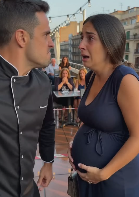
“What’s his name?” the officer asked.
“Adrián Soler.”
At the bar, Marcos made the smallest sound.
I heard it anyway.
“You know him,” I said.
Marcos stared at the floor.
Octavi smiled faintly again, recovering his mask. “Barcelona is a small city.”
The officer repeated, sharper, “Do you know Adrián Soler?”
Marcos said, “He worked with event suppliers.”
Rosa’s eyes widened. “No. He came last week.”
I turned to her.
She nodded slowly. “He asked about the terrace. About capacity. About whether cameras covered the balcony.”
My heart pounded so hard I felt it in my throat.
“He told me he wanted to surprise his wife with the view,” Rosa said, then looked at my belly and went pale. “I’m sorry.”
The officer asked the hostess to search emails.
Marcos said, “You need a warrant.”
The officer looked at him. “For a private business computer in an active public safety investigation involving assault and endangerment, we have enough to preserve evidence now.”
The hostess clicked through messages.
Then she found one from Adrián.
Subject: Balcony Placement.
The room went silent as the officer read.
Please place Verónica near the east railing. She gets nervous in crowded spaces and may cause a scene. If she complains, Marcos will know how to calm her down. Payment on arrival.
My lungs stopped working.
Marta whispered, “Payment?”
The hostess opened the attached receipt.
A transfer.
From Adrián Soler.
To Marcos Prieto.
Memo: private handling.
My hand went to my belly.
Not protectively this time.
As a promise.
My husband had not failed to arrive. He had sent me there.
Part 8: The Balcony She Never Fell From
Adrián arrived twenty minutes later pretending to be worried.
He stepped out of the elevator in a white shirt, hair perfect, phone in hand, face arranged into concern.
“Verónica,” he said. “What happened?”
Nobody moved.
I watched him search the room. First for me. Then for Marcos. Then for Octavi. Then for the police.
His concern cracked.
“Why are the police here?” he asked.
I stood slowly.
The paramedic tried to stop me, but I shook my head. I needed him to see me standing.
Not falling.
Not crying.
Not grateful to be rescued.
Standing.
“You paid them to put me near that railing,” I said.
Adrián’s eyes widened perfectly. Too perfectly. “What? No. Who told you that?”
The officer held up the printed email.
Adrián went still.
Only for a second.
Then he laughed. “This is absurd. I wanted her to have a good view. She misunderstands everything lately. Hormones, stress—”
I crossed the space between us and stopped close enough to see sweat at his hairline.
“You told them I might cause a scene.”
He lowered his voice. “Don’t do this here.”
I almost smiled.
He had no idea how finished that sentence was.
The officer asked Adrián to remain available for questioning. Another officer requested his phone. Adrián refused. Then Esteban stepped forward.
“I am terminating my firm’s contract with this venue,” he said. “And I’ll testify to everything I saw.”
Marta added, “So will I.”
Rosa. Iker. The security guard. The hostess. One by one, people who had been trained to stay quiet chose not to.
Adrián looked around the room and finally understood that volume would not save him.
Months later, the investigation revealed the rest.
Adrián had taken out a life insurance policy I knew nothing about. He had debts I knew nothing about. He had messages with Marcos discussing “a fright,” “a fall,” and “no direct involvement.”
He claimed it was all misunderstood.
The court did not agree.
Octavi lost the bar. Marcos lost his license to manage venues. Adrián lost the freedom he had gambled against my life.
I gave birth five weeks early, but my son came into the world furious, loud, and strong.
I named him Pau.
Not after pain.
After the waiter who marked the railing when nobody listened.
A year later, I returned to the same rooftop.
It was no longer a bar. The new owner had turned it into a public cultural terrace with low capacity, dry flooring, visible inspection records, and railings so solid that children leaned against them while their parents watched the sunset without fear.
Rosa managed the place.
Iker trained the staff.
Marta became my son’s godmother.
Near the east balcony, a small bronze plate read:
NO VIEW IS WORTH A LIFE.
I touched it with one hand while Pau slept against my chest.
That night, I finally understood the truth.
I had not ruined a party.
I had survived the trap they dressed up as one.
