Part 2: The Phone Nearly Disappeared Into The Water
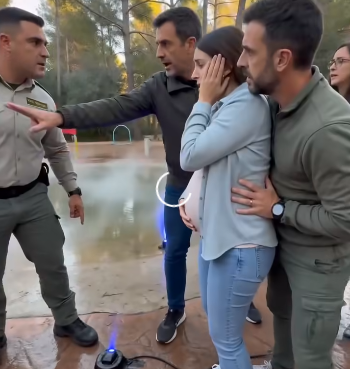
The hand shot forward so fast that the girl recording barely had time to twist away.
“Give me that,” the man hissed.
He was not the manager. He was younger, wearing a navy maintenance jacket with the park logo stitched crookedly over his chest. His fingers caught the edge of the phone, and for one horrible second, I saw it tilt toward the wet stones beside the artificial arroyo.
The girl screamed, “He’s trying to throw it!”
Then a man behind me shouted, “Nobody touch that phone.”
Everyone froze.
The voice belonged to a tall older man in a gray coat, standing near the wooden railing with a cane in one hand and a laminated visitor pass clipped to his pocket. His expression was calm, but his eyes were fixed on the taped button, not on the manager who had hit me.
The manager, Darío Valcárcel, swallowed.
“Señor Cifuentes,” he said, suddenly softer. “This is a misunderstanding.”
The older man stepped closer, his cane tapping once against the damp path.
“No,” he said. “This is exactly what I came to check.”
My cheek burned. The baby moved sharply inside me, and my hand went to my stomach before I could stop it. I hated that everyone saw. I hated that Darío saw, because his face immediately changed into that smug expression people use when they think your fear proves their version.
“She’s unstable,” he said. “She caused panic.”
“I asked why the fog machines were still on when the ground was flooded,” I said.
My voice shook, but it did not break.
The maintenance worker tried to back away, but the girl held her phone against her chest and stepped behind another visitor.
The older man pointed at the tape covering the emergency shutoff.
“Who sealed that?” he asked.
No one answered.
The fog curled around our ankles, thick and white, hiding the shallow dip where water had collected over the dark rubber surface. Children had been running there minutes earlier. Families had been taking photos there. I had been expected to walk through it because the mist made the park look magical on social media.
Darío gave a laugh that sounded empty. “It’s decorative.”
The older man bent down slowly and peeled one corner of the tape back with his cane tip.
Under it, the red button glowed faintly.
EMERGENCY STOP.
The crowd murmured.
Then a woman near the bridge whispered, “My son slipped there last month.”
Darío turned toward her.
And her face went pale, because she clearly had not meant to say it aloud.
Part 3: The Accident They Called A Game
The woman clutched a small red backpack to her chest as if it were the only thing keeping her upright.
Darío pointed at her. “Señora, don’t exaggerate.”
She shook her head. “No. I filed a report.”
“That report was reviewed.”
“You never answered it.”
The older man, Señor Cifuentes, looked at her carefully. “Your name?”
“Amalia Ríos,” she said. “My son slipped near this same fog section. He hit his shoulder. They told me he was running.”
A boy of about eight stood beside her, his arm held close to his body even now, weeks later. He looked at the fog like it might reach up and grab him again.
My throat tightened.
Darío’s slap had stunned me, but the boy’s silence frightened me more.
Señor Cifuentes took out his phone. “I am calling the municipal safety office.”
Darío moved quickly. “There’s no need.”
“There is every need.”
The maintenance worker who had tried to steal the phone muttered, “I only did what he told me.”
Darío snapped, “Iván, shut up.”
That was the first crack.
The girl recording lifted her phone again. “Say that again.”
Iván’s face flushed. He looked at Darío, then at the taped button, then at me.
“I was told to keep the fog running,” he said. “Even when the sensors detected water.”
The words landed harder than the slap.
Someone gasped. Another visitor cursed under his breath. A father picked up his daughter and carried her away from the mist.
Darío tried to smile. “He’s confused. Temporary staff.”
Iván shook his head. “I’m not confused.”
Señor Cifuentes stepped toward the control box fixed to a fake stone beside the arroyo. He opened the plastic cover. Inside, green lights blinked beside small labels.
Fog Zone A. Ground Moisture. Visibility Level. Override Active.
The last label glowed amber.
Override Active.
My body went cold.
“You knew,” I said to Darío.
He looked at me with hatred now, no mask left. “You have no idea what it costs to run a place like this.”
I almost laughed, because that was his defense. Money.
Then Amalia’s son spoke for the first time.
“It wasn’t a game,” he said quietly. “The fog came up before I fell.”
His mother covered her mouth.
Señor Cifuentes turned to Darío.
“Then why did your official report say the fog system was off?”
Part 4: The Report With The Missing Minute
Darío stopped moving.
Only the artificial fog kept drifting, sliding around shoes, wheels, stones, and the red emergency button that someone had tried to hide.
“The report was automated,” he said.
Señor Cifuentes looked at the control box. “Then the system log will confirm that.”
Iván whispered, “Unless it was edited.”
Darío lunged toward him, but two visitors stepped between them.
I stayed where I was, one hand on my stomach, the other gripping the railing. My cheek pulsed with heat. Every sound seemed sharper now—the water trickling over fake rocks, the buzz of hidden machines, the nervous breathing of people who realized they had brought their children into a staged danger.
A woman in a burgundy coat said, “I saw the manager arguing with staff this morning. He said the fog had to stay on for the influencer walk.”
“The what?” I asked.
She pointed toward a sign near the entrance.
MAGICAL MIST TRAIL — ZARAGOZA’S MOST PHOTOGRAPHED FAMILY WALK.
I stared at it.
So that was it.
Not safety. Not nature. Not families.
Photos.
Darío had slapped me because I had interrupted the illusion.
Señor Cifuentes called someone, gave the park location, then said, “Possible tampering with safety equipment, public assault, pregnant visitor at risk, prior incident reports.”
Pregnant visitor at risk.
Hearing myself described like that made my knees weaken.
Amalia noticed first. “Sit down.”
“I’m fine,” I lied.
“No, you’re not.”
She took my arm gently, not pulling, just offering. I sat on a bench damp with mist while her son stood beside me, solemn and protective in a way that made my chest ache.
The girl with the phone came closer. “I’m Clara. I sent the video to my sister already. He can’t delete it.”
Darío heard that.
His expression changed.
Not anger this time.
Panic.
He looked toward the visitor center, where a glass office overlooked the trail. A woman stood inside, watching everything through the window. She had short blonde hair, a pale scarf, and one hand pressed to her mouth.
Darío saw her too.
“Lucía,” he shouted. “Lock the office.”
She did not move.
“Lucía!”
Slowly, she opened the office door instead.
In her hand was a black tablet.
Darío’s voice dropped. “Don’t.”
Lucía walked down the ramp toward us, trembling.
Then she said, “The missing minute is not missing.”
Part 5: The Woman In The Glass Office
Lucía stopped beside the control box and held the tablet out to Señor Cifuentes.
“My name is Lucía Navarro,” she said. “I manage bookings and media visits.”
Darío laughed harshly. “You manage emails.”
Lucía did not look at him. “I manage the schedule you use to decide when safety rules can be ignored.”
The crowd went silent again, but this silence was different. It was not shock. It was attention.
Señor Cifuentes took the tablet.
On the screen was a dashboard with rows of time stamps.
08:14 — Moisture Alert.
08:16 — Visibility Warning.
08:17 — Auto Shutdown Initiated.
08:17 — Manual Override.
08:18 — Emergency Stop Covered.
08:19 — Influencer Group Entry.
A cold wave passed through me.
The emergency stop had not just been taped over at some vague time.
It had been covered right before the crowd entered.
Right before I asked.
Right before Darío hit me.
Clara zoomed her phone toward the screen.
Darío pointed at her. “That is confidential company data.”
Lucía finally looked at him.
“No,” she said. “It is evidence.”
His face darkened. “You signed the same nondisclosure agreement as everyone else.”
“I signed it after you threatened to fire me for asking about Diego.”
At that name, Amalia’s son looked up.
“Who is Diego?” I asked.
Lucía’s eyes filled.
“My brother.”
Darío took one step back.
Señor Cifuentes’s jaw tightened. “Diego Navarro?”
Lucía nodded.
The older man exhaled slowly. “The technician who supposedly resigned after the first incident.”
“He did not resign,” Lucía said. “He disappeared from the schedule after refusing to falsify the log from Amalia’s son’s fall.”
The machines hummed beneath the path.
Darío shook his head. “This is madness.”
Lucía touched the tablet screen, opened another file, and turned it toward us.
It was a video.
A narrow maintenance corridor. Diego, a thin young man in an orange vest, arguing with Darío beside a panel of switches.
The audio was faint, but one sentence came through clearly.
“If a child falls again, it will be on you.”
Then the video cut to black.
Lucía’s voice trembled.
“He sent me that clip the night he vanished.”
Darío whispered, “Careful, Lucía.”
She looked at him with years of fear breaking behind her eyes.
“I was careful,” she said. “That was the problem.”
Part 6: The Locked Door Beneath The Trail
The municipal officers arrived ten minutes later, followed by two Guardia Civil agents and a medical responder who came straight to me.
Darío tried to turn the scene into noise.
He talked over Lucía. He called Iván a liar. He called Clara a teenager hungry for attention. He called me reckless, emotional, dangerous, ungrateful.
The officer listened to him for exactly twenty seconds.
Then she said, “Señor Valcárcel, step away from the control box.”
He did not.
So another agent stepped closer, and Darío finally moved.
The medical responder checked my pulse, then my blood pressure. His face stayed professional, but his mouth tightened slightly.
“You need to be examined,” he said. “Stress and impact are not small things during pregnancy.”
“I will,” I said. “But not before they shut this down.”
He looked toward the fog.
The municipal officer had already pressed the emergency stop after cutting the tape with a pocket blade. The machines died one by one.
For the first time, the path cleared.
And that was when everyone saw the second danger.
Without the fog, the water was visible. It was not a thin wet sheen. It had gathered in a long, uneven channel across the walkway, deep enough to hide the raised metal strip where the artificial forest lighting was installed.
A woman muttered, “My God.”
Amalia pulled her son closer.
Iván pointed toward the fake rock wall near the arroyo. “There’s a service door under the trail.”
Darío spun toward him. “You don’t have access.”
“No,” Iván said. “But Diego did.”
Lucía went still.
The officers followed Iván to a disguised panel behind hanging artificial vines. One of them pulled the vines aside and found a small gray door with a keypad.
“Code?” the officer asked.
Nobody answered.
Then Lucía whispered, “Try Diego’s birthday.”
Darío’s eyes flashed.
The officer entered four numbers.
The lock clicked.
Behind the door, a narrow stairway descended beneath the mist trail.
The smell came up first: damp wiring, standing water, metal, mold.
I stood despite the responder’s protest. I needed to see. Maybe I should not have, but after being called dramatic for noticing danger, I needed proof with my own eyes.
The officer shone a flashlight down the stairs.
At the bottom sat stacked plastic boxes, old uniforms, and a broken orange safety helmet.
Lucía made a sound like she had been struck.
On the helmet, written in black marker, was one name.
DIEGO.
Part 7: The Brother Who Left A Warning
Lucía tried to go down the stairs, but the officer stopped her gently.
“Wait.”
“No,” she said, shaking her head. “That’s his.”
Her voice had gone small, almost childlike.
Darío folded his arms. “A helmet proves nothing.”
But his forehead was wet now, and not from fog.
The officers entered the service space. We heard them moving below, opening boxes, calling out item numbers. One came back up holding a sealed plastic folder.
Inside were printed maintenance sheets.
Not one.
Dozens.
All signed by Diego Navarro.
All marked unsafe.
Dates. Moisture failures. sensor warnings. automatic shutdown errors. recommendations to close the mist trail until drainage was repaired.
Every sheet had a red stamp across it.
CANCELLED.
Lucía covered her mouth.
Señor Cifuentes took off his glasses and rubbed his eyes.
Darío said, “Old drafts.”
Iván shook his head. “No. I saw him file those.”
The officer opened another folder. This one held a handwritten note, sealed in a transparent evidence sleeve.
Lucía recognized the writing immediately.
“My brother,” she whispered.
The officer read only part of it aloud.
“If I disappear from this job, check the service room under the trail. He is hiding the reports there because investors arrive on Friday.”
Investors.
That word made Darío flinch more than Diego’s name had.
Señor Cifuentes looked at him. “You kept the attraction open for an investor tour?”
Darío said nothing.
Lucía closed her eyes. “Friday was the day after Diego vanished from the schedule.”
“Where is he?” I asked.
Nobody seemed to want to answer.
Then Amalia’s son lifted his hand timidly.
“I saw a man in an orange vest,” he said.
His mother turned. “Mateo?”
The boy swallowed. “The day I fell. He helped me stand. He told me not to come back to the fog path. Then the manager yelled at him. Later, when we were leaving, I saw him near the delivery gate. He got into a white van.”
Lucía stepped closer. “Did he look hurt?”
Mateo shook his head. “No. But he looked scared.”
The officer crouched to Mateo’s level. “Did you see anything on the van?”
He thought hard.
“A blue shell,” he said. “Like a seafood picture.”
Iván suddenly whispered, “Calatayud.”
Everyone turned to him.
“There’s a closed aquarium warehouse near Calatayud,” he said. “Same shell logo. Darío used it for storage before the park opened.”
Darío bolted.
He made it three steps before the Guardia Civil caught him.
And as they forced his hands behind his back, Lucía said, “My brother may still be alive.”
Part 8: The Trail That Finally Cleared
They found Diego before dawn.
Not in a cellar. Not chained. Not in the dramatic way fear had painted in Lucía’s mind.
They found him in a small rural clinic outside Calatayud, registered under a false surname after a head injury and months of confusion. The owner of the old warehouse had brought him there anonymously, claiming he had discovered him near the loading area after a fall.
Diego was alive.
When Lucía heard it, she did not scream. She simply sat down on the wet curb outside the park entrance and pressed both hands to her face while her shoulders shook.
I was already in the ambulance, wrapped in a foil blanket I did not remember accepting.
Clara sat near the open doors, still holding her phone like a torch.
“You saved the video,” I told her.
She shook her head. “You saved the moment. I only recorded it.”
At the hospital, they checked the baby again.
A steady heartbeat filled the room.
Fast. Strong. Real.
I cried then, not loudly, but with the kind of relief that makes your whole body hurt afterward.
Three weeks later, the mist trail was closed by order of the city. Darío Valcárcel faced charges for assault, safety tampering, falsified records, and obstruction. The investors withdrew so quickly that the park’s owners tried to pretend they had always cared about safety.
But the part nobody expected came from Diego.
Once his memory returned in pieces, he gave a statement. Darío had not meant to kill him. That almost made it worse. He had meant to frighten him, ruin him, erase his credibility, and let time do the rest.
Diego asked for one thing in return for testifying fully.
Not money.
Not revenge.
He asked that the artificial forest be reopened only if it became a public rehabilitation garden for injured children, pregnant visitors, elderly walkers, and anyone who needed a path that did not punish them for moving carefully.
Six months later, I returned with my daughter in my arms.
The fog machines were gone.
The emergency buttons were uncovered and bright red.
The trail had handrails, dry stone, open signs, clear exits, and small plaques explaining every safety feature in plain language.
Lucía was there with Diego, who walked slowly with a cane beside Señor Cifuentes. Amalia and Mateo had come too. Clara filmed nothing that day. She said some moments deserved to be lived without proof.
Near the arroyo, a new sign had been placed.
HELENA’S PATH.
I laughed when I saw it, embarrassed, overwhelmed, trying not to cry.
Lucía touched my shoulder. “It was Diego’s idea.”
Diego smiled gently. “No. It was your question.”
I looked down at my daughter, sleeping against my chest, her tiny fist resting over my heart.
All I had done was ask why the path was unsafe.
But sometimes, one woman refusing to walk through danger is enough to clear the way for everyone who comes after her.
